

Indiana University –Global and International Studies Building
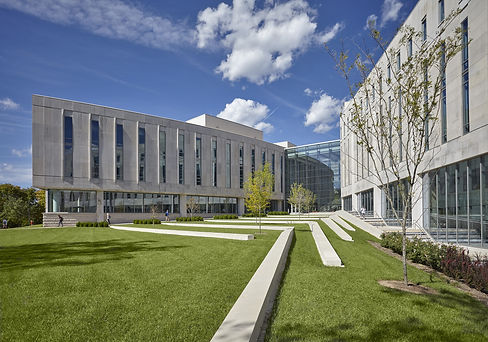
The Global and International Studies Building is a new academic facility designed to consolidate multiple departments and research centers focused on global studies, foreign languages, and cultural disciplines under one roof. The program includes classroom and collaboration spaces, an auditorium, language and cultural resource centers, faculty offices, and student gathering zones. Set within a context of distinct campus geometries and sloping landscape, the design interweaves formal wings, a transparent atrium, and outdoor terraces to make the building both a hub for interdisciplinary exchange and a landmark for global learning. The total size is approximately 165,000 square feet, and the project pursued high standards of sustainability.
Construction Experience
Constructing this facility involved balancing complex site constraints, varied geometries, and integrating advanced architectural detailing with high-performance building systems. The building consists of two limestone-clad wings unified by a three-story glass-enclosed central atrium, which necessitated precise structural coordination between masonry, glass, steel framing, and curtainwall systems. The project incorporated energy- and daylight-responsive systems: lighting that dims or switches off when rooms are unoccupied; HVAC and ventilation that adjust based on occupancy; use of high-efficiency plumbing fixtures. Careful attention was paid to sourcing materials consistent with campus tradition—locally quarried limestone—while also introducing colored stones from around the world as accents and in interior public features. LEED certification (Gold) was achieved through these integrated strategies.
Impact & Benefits
The building delivers numerous operational, educational, and symbolic benefits. Functionally, it brings together programs that were formerly dispersed, enabling richer collaboration, more efficient faculty and student use of space, and improved technological and research infrastructure. The enhanced daylight, views of surrounding landscape, and generous communal spaces foster greater user comfort and also support the wellbeing of students and staff. From a sustainability standpoint, the building reduces energy and water use through its efficient systems, helping lower lifecycle maintenance and operational costs. Symbolically, it stands as a manifest representation of global academic engagement, bridging traditional campus architecture with materials and forms that express cultural diversity—reinforcing the institution’s mission in global and international studies.
