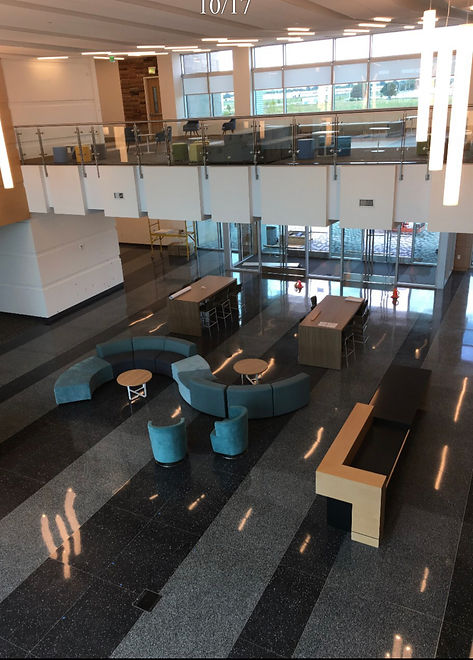
Infosys North America Headquarters
This project entailed the creation of a large-scale, state-of-the-art training and innovation campus for a major global technology and consulting firm. It replaced or repurposed part of a former airport facility, turning a previously underused site into a center for workforce development, technological skills training, and corporate R&D. The design includes classroom and lab spaces, residential accommodation for trainees, meeting halls, office spaces, and outdoor amenities, all intended to support both internal employees and clients/partners participating in upskilling and innovation programs. Sustainability, flexibility, and long-term growth were central to the planning, with the campus envisioned in phases to allow future expansion.

Construction Experience
From a construction standpoint, the build-out involved both new construction and substantial infrastructure work. The initial phase covered over 125,000 square feet, including the training & educational facilities plus a residential component. Systems installed feature high-performance building envelope elements, modern HVAC, energy-efficient lighting, and sustainable materials. The team placed focus on life-cycle performance: using materials with low embodied carbon, selecting concrete technologies that reduce CO₂ content, and implementing waste reduction practices. The construction delivery was coordinated across multiple trades and disciplines (structural, mechanical/electrical/plumbing, site work, finishes, etc.), to meet ambitious energy performance goals and provide spaces with high occupant comfort, accessibility, and adaptability to different program uses.
Impact and Benefits
Once operational, the facility delivers multiple benefits: lower operating costs thanks to energy-efficient systems and sustainable materials; enhanced capacity to train and reskill a large workforce in contemporary tech fields; improved quality of built environment (better light, air, amenities) which supports productivity, learning, and well-being. It also revives a large underutilized parcel, contributing to site revitalization and community economic benefit. Finally, because of its sustainable design, it underscores the organization’s commitment to environmental responsibility, setting a benchmark for similar training or innovation hubs, and encouraging the industry to adopt higher performance standards in both new construction and adaptive reuse.